Early Pregnancy – Including HCG levels and ultrasound findings
When pregnancy begins depends on how “pregnancy’ is defined.
Background
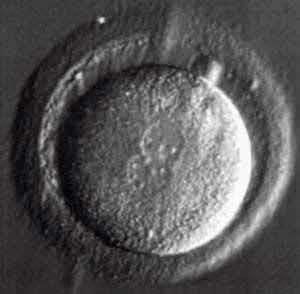
Does it begin when the sperm first penetrates the egg? Does it begin when the male and female pronuclei (see picture below) containing the chromosomal material move close together and decondense in the newly fertilized egg?
Human zygote embryo several hours after fertilization
2 circular structures (pronuclei) in the center contain maternal and paternal DNA
Sperm and egg were put together 16 hours ago
Does pregnancy begin when the male and female chromosomes pair up with each other and the fertilized egg subsequently divides into a 2-cell embryo?
Does it begin when the embryo implantation begins about 6 to 8 days after ovulation?
Or, does it begin when the woman recognizes that she is pregnant after her missed menstrual period and positive pregnancy test?
HCG levels in pregnancy
HCG, or human chorionic gonadotropin, is a hormone made by the pregnancy that can be detected in the mother’s blood or urine even before the woman’s missed period. This hormone is what we look for with a “pregnancy test”.
HCG is first detectable in the blood as early as 7-8 days after ovulation by very sensitive HCG assays (research assays). In real life, blood pregnancy tests will be positive (> 2 mIU/ml) by 10-11 days after HCG injection or LH surge.
In general, the HCG level will double every 2-3 days in early pregnancy.
85% of normal pregnancies will have the HCG level double every 72 hours.
HCG levels peak at about 8-10 weeks of pregnancy and then decline, remaining at lower levels for the rest of the pregnancy.
There is a large variation in a “normal” HCG level for any given time in pregnancy.
Pregnancies destined to miscarry and ectopic (tubal) pregnancies tend to show lower levels (eventually), but often have normal levels initially.
Learn about pregnancy after ectopic pregnancy
Some normal pregnancies will have quite low levels of HCG – and deliver perfect babies. Caution must be used in making too much of HCG “numbers”. Ultrasound findings after 5-6 weeks of pregnancy are much more predictive of pregnancy outcome than are HCG levels.
For women that have had an HCG injection as part of their fertility treatment, the hormone takes about 5-14 days to clear from her system, depending on the dose and the individual woman. This can causes problems with interpretation of pregnancy tests done earlier than 14 days after an HCG injection.
HCG levels from normal singleton pregnancies (and twins below)
Levels are listed for various days after the ovulatory HCG injection or LH surge
First (same as Third) International Reference Preparation was used
“High” is highest seen in this group of pregnancies
“Low” is lowest seen in this group of pregnancies
“#” is the number of tests done for that day in this group of pregnancies
The values below are from a group of 53 normal singleton pregnancies. Because this is a very small group of patients and because lab assays vary, it is important not to rely on these values to determine whether your pregnancy is viable, a single, a twin, etc.
Check with your physician about your own levels
Day after HCG or LH
Average
mIU/ml
High
mIU/ml
Low
mIU/ml
#
14
48
119
17
12
15
59
147
17
18
16
95
223
33
23
17
132
429
17
21
18
292
758
70
19
19
303
514
111
23
20
522
1690
135
13
21
1061
4130
324
12
22
1287
3279
185
22
23
2034
4660
506
13
24
2637
10000
540
16
The information in the table above is part of a study carried out by Dr. Sherbahn that compared HCG levels from single, twin and heterotopic (combined intrauterine and ectopic) pregnancies.
The site uses cookies, pixels and other similar technologies, as further described in our privacy statement. By using our site, you agree to our use of cookies.