Body mass index and its effect on infertility and in vitro fertilization success rates
Background
A woman’s weight can affect her fertility. We know that at both extremes, very thin and obese, that there can be disruption of the normal process of regular, consistent ovulation. Anovulation can often result. Medications can be used to induce ovulation in these women in an attempt to become pregnant.
Body mass index, or BMI, is an index of a person’s relative “skinniness or heavyness”. The BMI factors in a person’s weight and their height to give an overall “index”.
A high BMI indicates obesity:
- A standard medical definition of “normal” body weight is a BMI of about 18.5 – 24.9
- A BMI under 18.5 indicates that the person is “underweight”
- A BMI of 25.0 – 29.9 indicates that the individual is “overweight”, but not obese
- A BMI over 30 indicates obesity
- A BMI over 40 indicates extreme obesity
Obesity is associated with increased risk for several serious disease processes. Extreme obesity is associated with a dramatically increased risk for many serious diseases. The web site weight.com is a good place to start learning more about those risks, as well as weight loss issues, etc.
Body mass index is calculated with this formula:
weight (in kilos) divided by height (in meters) squared
Therefore, if someone weighs 100 kilos and is 1.8 meters tall, their BMI is:
100 divided by 1.8 X 1.8 = 100/3.24 = 30.9
To convert from pounds to kilos, take the weight in pounds and divide it by 2.2
To convert from inches to meters, take the height in inches times 0.0254
View a BMI table showing how to get your BMI from your height and weight
(PDF file download)
Go to WebMD to learn more about weight issues related to general health and weight loss
Search for “weight control” to get started.
Some recently published studies have shown a relationship between BMI and in vitro fertilization success rates. We have reviewed our own IVF data and found that increased body weight (BMI > 30) has a significant negative effect on IVF pregnancy success rates. Some of our data is summarized in the graph below:
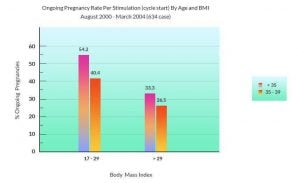
- This graph shows the relationship between body mass index (BMI) and ongoing (beyond 12 weeks) IVF pregnancy rates.
- Data is for all women under 40 that had ovarian stimulation for IVF (cycle starts) in our center from August 2000 to March 2004.
- The columns on the left show ongoing pregnancy rates for non-obese women (BMI 17-29)
- The columns on the right show ongoing pregnancy rates for obese women (BMI >29)
- Grey columns are for women less than 35 years old
- Red columns are for women 35-39
Bottom line:
If you are obese (BMI of 30 or higher) and need IVF, you might have a significantly improved chance for success if you reduce your weight before going through the procedure.
Body weight and safety of IVF procedures:
Another issue related to body weight and IVF is safety for the patient at the egg retrieval. As can be seen in the ultrasound images below, when a woman is significantly overweight, the ovaries are usually pushed up “high” – away from the top of the vagina by the extra fatty tissue that is in the pelvis.
At the time of IVF, the needle is pushed in vaginally to reach the eggs in the ovaries. If the ovaries are too high, we can not safely get the needle into the follicles to get the eggs out.
Another problem is that the ultrasound images become very “fuzzy” from the extra tissue between the probe and the ovary. Therefore, it is often difficult to clearly visualize the ovaries and the egg-containing follicles.
This is shown below – the ovary in the image on the right is very fuzzy and indistinct. This makes it difficult to properly measure the follicles in the ovaries, and can also make it hard to be sure where the needle tip is located at all times during the egg retrieval procedure (a potential safety issue).
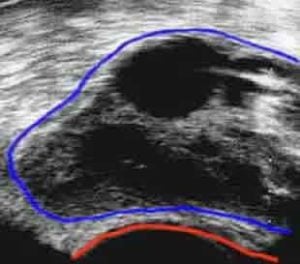
Ultrasound picture taken during an IVF egg retrieval procedure. This woman has a normal BMI of 24. Ovary circled in blue. Red line is top of vagina. Area between red and blue lines is tissue at top of vagina. Needle (right side of image at white dots) goes through the top of vagina to get eggs. The ovary is “low” – on top of the vagina – where it should be for a safe egg retrieval.
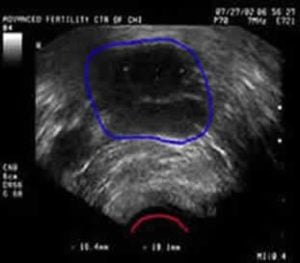
Obese woman with a BMI of 37. We were not able to retrieve the eggs. Ovary circled in blue. Red line is top of vagina. Area between red and blue lines is tissue at the top of the vagina, fatty tissue and possibly bowel. Cutting through this with the needle to get to the eggs is not safe. A complication could occur from cutting bowel, blood vessels, etc. This ovary is “high” above the vagina in the abdomen.