

Numerous studies have documented the increased risk for miscarriage (pregnancy loss) and increase in infertility as women age.
Background
As women get older the incidence of chromosomally abnormal eggs increases dramatically. This results in lower chances for getting pregnant at all, as well as increasing the risk of miscarriage.
Maternal Age and Pregnancy Loss Rate
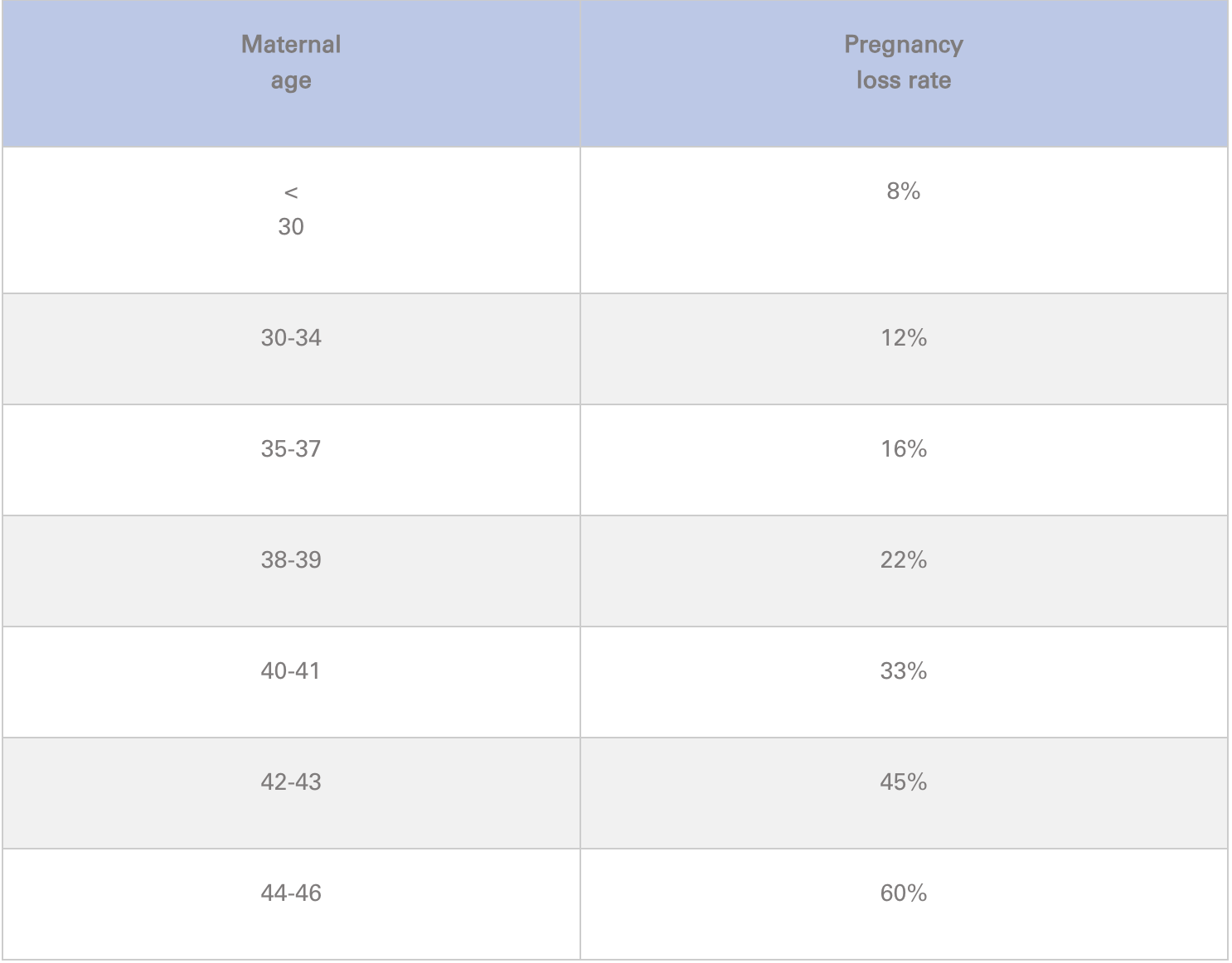
Miscarriage data from the annual government CDC IVF report
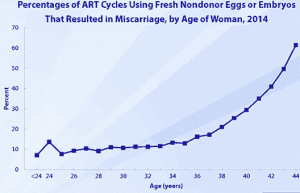
The graph below shows information about miscarriage rates after IVF (using own eggs) from the 2012 CDC report.
- The CDC data only includes pregnancy losses after ultrasound confirmed pregnancy
- Miscarriage rates would be higher if early miscarriages (such as “chemical pregnancies”) were included.
- The miscarriage rate after ultrasound confirmation of pregnancy was approximately:
- Under 15% at age 35 and under
- 29% at age 40
- 60% at age 44
- And higher after age 44
History of Infertility and Pregnancy Loss Rate
Miscarriage rates for women with a history of infertility tend to be higher than for fertile women.
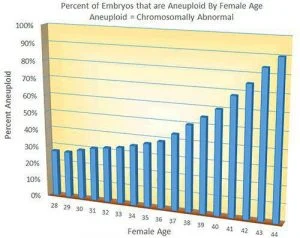
The main reason for the increased risk for miscarriage in “older” women is due to the increase in chromosomal abnormalities (abnormal karyotype) in their eggs. Note the similarity in the shape of the curve in the graph above to the one below showing the rate of chromosomal abnormalities in IVF embryos by age.
The pictures below are from this journal article. These photos were taken with confocal fluorescence microscopy of eggs stained with special dyes to show the spindles and chromosomes.
Ready for an Appointment in the Chicago Area?
If you’re ready to explore treatment, contact the award-winning team at AFCC.
Find a Prelude Fertility Clinic Location Near You
The Prelude Network is the fastest-growing network of fertility centers in North America.
Chromosomal Problems in Aging Eggs
Many studies have documented the increased rate of chromosomal abnormalities in women of advanced reproductive age. The graph below shows the rate of chromosomally abnormal IVF eggs by female age (compiled from several studies).
We do not know exactly why there is an increase in chromosomal abnormalities in the eggs of women as they age. However, research has clarified some of the issues involved.
- The meiotic spindle is a critical component of eggs that is involved in organizing the chromosome pairs so that proper division of pairs can occur as the egg is developing.
- When the chromosomes line up in a straight line on the spindle, the division process should proceed normally.
- However, with a disordered arrangement on an abnormal spindle, the division process may be uneven – resulting in an unbalanced chromosomal situation.
- Older eggs are significantly more likely to have abnormal spindles – which predisposes to development of chromosomally abnormal eggs.
Preimplantation genetic screening (PGS) can test IVF embryos before transfer to determine if they are chromosomally normal or not.