

Blastocyst embryo grading pictures and photos from IVF, In Vitro Fertilization
Definition of a blastocyst:
- An embryo which has developed to the point of having 2 different cell components and a fluid cavity
- Human embryos from in vitro fertilization in culture in an IVF lab, or developing naturally in the body, usually reach blastocyst stage by day 5 after fertilization
- Blastocyst transfer with IVF can give high pregnancy success rates with very low risk of triplets
- See our 5 day blastocyst transfer success rates
- See our overall IVF success rates
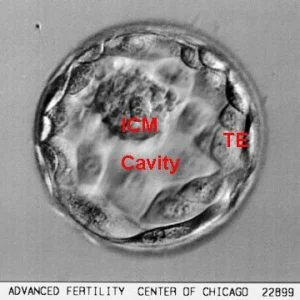
Picture of a high quality expanded human blastocyst embryo 5 days after fertilization
The clump of cells in the 10 to 12 o’clock area is the inner cell mass (ICM) which become the fetus
The trophectoderm cells (TE) that will form the placenta surround the fluid cavity
The fluid-filled blastocoel cavity is in the center
Blastocyst Development and Blastocyst Quality Grading (or scoring)
- There are 3 distinct parts to a blastocyst – the two cell types and the fluid cavity (see picture above)
- As development of blastocysts progresses, cells in the 2 components divide and the fluid cavity enlarges
- With continued blastocyst development the embryo expands, the shell thins, and it hatches from its shell
- Blastocyst implantation into the lining of the uterus can then begin
Our IVF clinic and many others that do blastocyst culture and transfer use a blastocyst scoring system originally developed and published by Dr. David Gardner in the late 1990’s. Dr. Gardner is well known for being first to develop a commercially available embryo culture media system that supported high rates of viable blastocyst development. There are other grading systems for blastocysts, but this one is most widely used.
Ready for an Appointment in the Chicago Area?
If you’re ready to explore treatment, contact the award-winning team at AFCC.
Find a Prelude Fertility Clinic Location Near You
The Prelude Network is the fastest-growing network of fertility centers in North America.
The Gardner blastocyst grading system assigns 3 separate quality scores to each blastocyst embryo:
- Blastocyst development stage – expansion and hatching status
- Inner cell mass (ICM) score, or quality
- Trophectoderm (TE) score, or quality
| Expansion grade |
Blastocyst development and stage status |
|---|---|
| 1 |
Blastocoel cavity less than half the volume of |
| 2 |
Blastocoel cavity more than half the volume of |
| 3 |
Full blastocyst, cavity completely filling the |
| 4 |
Expanded blastocyst, cavity larger than the |
| 5 |
Hatching out of the shell |
| 6 |
Hatched out of the shell |
| ICM grade | Inner cell mass quality |
|---|---|
| A |
Many cells, tightly packed |
| B |
Several cells, loosely grouped |
| C |
Very few cells |
| TE grade | Trophectoderm quality |
|---|---|
| A |
Many cells, forming a cohesive layer |
| B |
Few cells, forming a loose epithelium |
| C |
Very few large cells |
Blastocysts are given a quality grade for each of the 3 components and the score is expressed with the expansion grade listed first, the inner cell mass grade listed second and the trophectoderm grade third.
For example, a blastocyst quality grade of 4AB means that the blastocyst is expanded (grade 4), has many tightly packed cells in the inner cell mass (grade A), and has a trophectoderm with few cells forming a loose epithelium (grade B). See the examples of blastocyst grading pictures below.
There are other blastocyst grading systems, including the grading that we use in our IVF program (see below). Some use more letter grades than the Gardner system. For example, some clinics give component cells grades of D or even E in addition to the A, B and C grades described above.
We have seen records from some labs that give blastocysts a single letter grade, and no number at all. For example the blasts are simply graded as A’s or B’s or C’s, etc. This system is easier for lab personnel to deal with but at the cost of being less descriptive. There is also some loss of correlation between grading of the blastocysts and expectations for successful pregnancy outcome.
Blastocyst embryo grading is helpful. However, the potential of the embryo to continue normal development, implant and result in a healthy baby born is difficult to predict based on grading alone.
Assessment of an embryo’s chromosomal status using preimplantation genetic testing for aneuploidy (PGT-A) along with standard morphology grading is the current gold standard for selection of the “best” embryo for transfer.
- A pretty embryo is good, but pretty and chromosomally normal is much better
Early blastocyst grading photos:
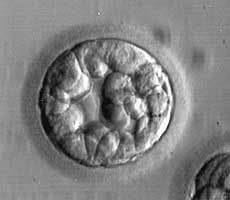
very small = Can’t yet grade
volume = 1
Inner cell mass = Can’t yet grade
Trophectoderm = Can’t yet grade
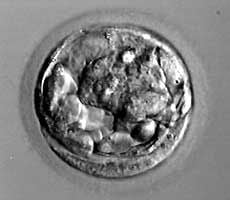
Cavity very small = Can’t yet grade
Inner cell mass = Can’t yet grade
Trophectoderm = Can’t yet grade
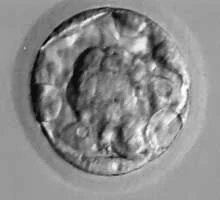
Cavity < 1/2 embryo’s
Inner cell mass = A
Trophectoderm = B
Large, expanded blastocyst grading images:
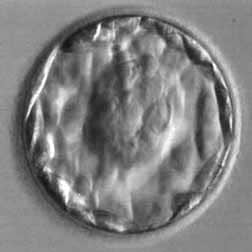
Well expanded = 4
Inner cell mass = B
Trophectoderm = A
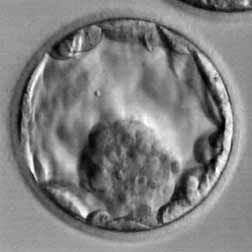
Well expanded = 4
Inner cell mass = A
Inner cell mass = B
Trophectoderm = B

Well expanded = 4
Inner cell mass = B
Trophectoderm = B
Hatching and hatched blastocyst grading pictures:
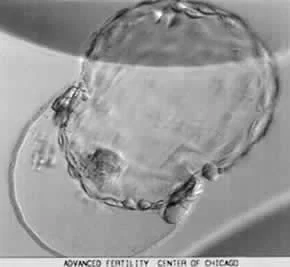
Blastocyst hatching out of shell = 5
Inner cell mass = A
Trophectoderm = A
Picture of a hatching blastocyst on day 6 of in vitro culture
It is almost completely hatched out of its shell (seen at lower left of image).
After a blastocyst hatches, it begins to invade into the uterine lining to “implant”.
This embryo has a quality grade of 5AA (inner cell mass seen at the bottom is out of the plane of focus).
The dark areas at the top and lower right of the photo are shadows in the drop of culture media.
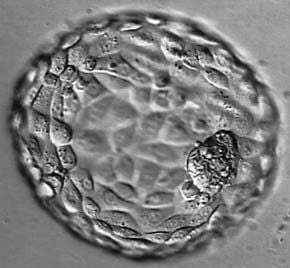
Blastocyst hatching out of shell = 6
Inner cell mass = A
Trophectoderm = A
Completely hatched blastocyst
This embryo has a quality grade of 6AA
The tightly packed inner cell mass seen at 3 to 4 o’clock in this picture
A healthy blastocyst will implant within one to four days following a day 5 transfer, with invasion of the cells into the uterine lining occurring soon after blastocyst hatching.
Our blastocyst grading system at the Advanced Fertility Center of Chicago
- We use a modified version of the Gardner grading system because our embryologists can not stand to be limited to only 3 grading levels for ICM and TE cells
- The expansion grading is the same as Gardner’s
- We use 4 grades, A-D for the ICM and TE
- A is the same as Gardner’s A
- B is “not quite A, but still quite good”
- C is “not quite B, but not bad”
- D is for very few cells and/or poor quality cells