

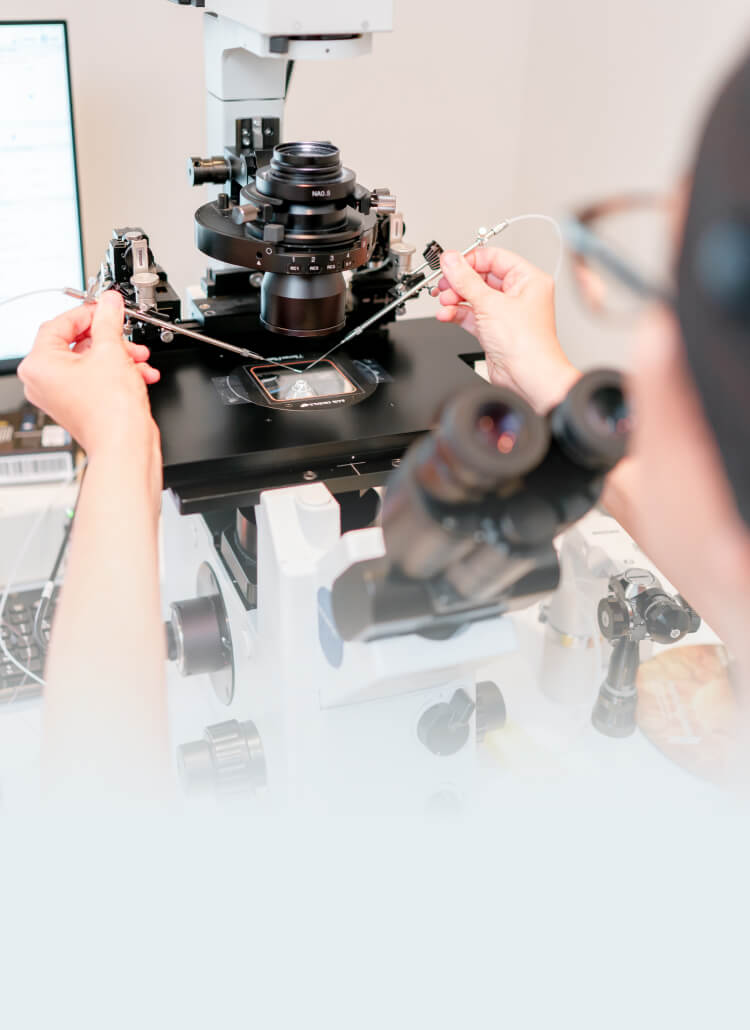
Intracytoplasmic sperm injection - ICSI and IVF
Highly effective treatment for male factor infertility problems
Advanced Fertility Center of Chicago
Infertility and In Vitro Fertilization Specialist Clinic
Gurnee & Crystal Lake, Illinois
Our IVF Success Rates
Our IVF with Donor Eggs Success Rates
What is ICSI?
ICSI is an
acronym for intracytoplasmic sperm injection - which is a long, fancy way of
saying "inject sperm into the middle of the egg". ICSI is a very
effective method to get fertilization of eggs in the IVF lab after they have
been retrieved from the female partner. IVF with ICSI involves the use of
specialized micromanipulation
tools and equipment
and inverted microscopes that enable embryologists to select and then pick up
individual sperms in a tiny specially designed hollow ICSI needle. Then the
needle is carefully advanced through the outer shell of the egg and egg membrane
and the sperm is then injected into the inner part (cytoplasm) of the egg.
This will usually result in normal fertilization in approximately 70-85% of eggs
injected with viable sperm. First, the woman must be stimulated with medications and have an egg
retrieval procedure so that we can obtain several eggs in order to
attempt in vitro fertilization and ICSI.
See a series of images demonstrating
the ICSI technique
Who should be treated with
intracytoplasmic sperm injection?
There is no "standard of
care" in this field of medicine regarding which cases should have the ICSI
procedure and which should not. Some clinics use it only for severe male factor
infertility, and some use it on every case. The large majority of IVF clinics
are somewhere in the middle of these 2 extremes. Our thinking has changed over
time - we are now doing more ICSI (as a percentage of total cases) than in the
past. Certainly, as we learn more about ways that we can help couples conceive,
our thinking in this area will continue to evolve. Having said that, we are
currently recommending in
vitro fertilization (IVF) with ICSI for:
1. All couples with severe male factor infertility that do not want donor sperm insemination.
2. All couples with
infertility with:
Sperm
concentrations of less than 15-20 million per milliliter
OR
Sperm motility less than 35%
OR
Very poor sperm morphology (subjective - specific cutoff value is not
appropriate)
3. All couples having IVF who have had a previous cycle with no fertilization - or a
low rate of fertilization (low percentage of mature eggs that are normally
fertilized).
4. All couples having IVF who have
a very low yield of eggs at the egg retrieval - our current cutoff is 5-6 (or less)
eggs. In this scenario, ICSI is being used to try to get a higher percentage
of eggs fertilized than with conventional insemination of the eggs (just
mixing eggs and sperm together).
How is ICSI performed?
1. The mature egg is held with a
specialized holding pipette.
2. A very delicate, sharp and hollow
needle is used to immobilize and pick up a single sperm.
3. This needle is then carefully
inserted through the zona (shell of egg) and in to the cytoplasm of the egg.
4. The sperm is injected in to the
cytoplasm and the needle carefully removed.
5. The eggs are checked the next
morning for evidence of normal fertilization.
ICSI fertilization procedure in progress
Needle with a sperm inside is advanced to the left
Shell of embryo has already been penetrated by needle
Membrane of egg (oolemma) is stretching and is about to break
Sperm head visible at tip of needle
More
ICSI images
Fertilization
and pregnancy
success rates with ICSI
Fertilization rates for ICSI: Most IVF programs
see that about 70-85% of eggs injected using ICSI become fertilized. We call
this the fertilization rate, which is different from the pregnancy rate.
Pregnancy success rates for in vitro
fertilization procedures with ICSI have been shown in some studies to be higher than for
IVF without ICSI. This is because in many of the cases needing ICSI the female is
relatively young and fertile (good egg quantity and quality) as compared to
some of the women having IVF for reasons other
than male factor infertility. Another way to say this is - average egg quantity and quality
is usually better in ICSI cases (male factor cases) because it is less likely that there is a problem
with the eggs - as compared to cases with unexplained
infertility in which there is more probability of a somewhat reduced egg quantity and quality
(on the average, since some women in this group have egg related issues).
ICSI success rates vary according to the
specifics of the individual case, the ICSI technique used, the skill of the individual
performing the procedure, the overall quality of the laboratory, the quality of
the eggs, and the embryo transfer skills of the
infertility specialist physician performing the
procedure.
Sometimes IVF with ICSI is done for
"egg factor" cases - low ovarian
reserve situations. This is when there is either a low number of eggs,
or lower "quality" eggs (or often both). In such cases,
ICSI fertilization and pregnancy success rates are somewhat lower (as a group) since the main determinant of IVF success is
the quality of the transferred embryos - and the quality of the eggs is the
most
crucial factor determining the quality and viability of the resulting embryo.
In some cases, assisted
hatching might be done on the embryos prior to transfer, in order to maximize chances
for pregnancy.
Our
IVF pregnancy success rates
See
a general discussion about IVF pregnancy success rates
Cost of
IVF with ICSI
See the IVF pricing
page for details regarding the cost of ICSI at our IVF clinic. Both costs and
pregnancy success rates can vary greatly between different IVF clinics.