

Learn More About IVF Success Rates with AFCC
We are here to answer any questions or concerns you may have so that you feel completely confident when taking the first step toward building your family.
From fertility struggles to parenthood — read Jessi & Alessio Pasini's inspiring IVF journey.
From fertility struggles to parenthood—read Jessi & Alessio Pasini's inspiring IVF journey.
We are proud to announce that Castle Connolly has recognized Dr. Catenacci as a 2026 Top Doctor!
We're thrilled to announce Dr. Michelle Catenacci has been named a 2026 Castle Connolly Exceptional Woman in Medicine!
We're thrilled to announce Dr. Michelle Catenacci has been named a 2026 Castle Connolly Exceptional Woman in Medicine!


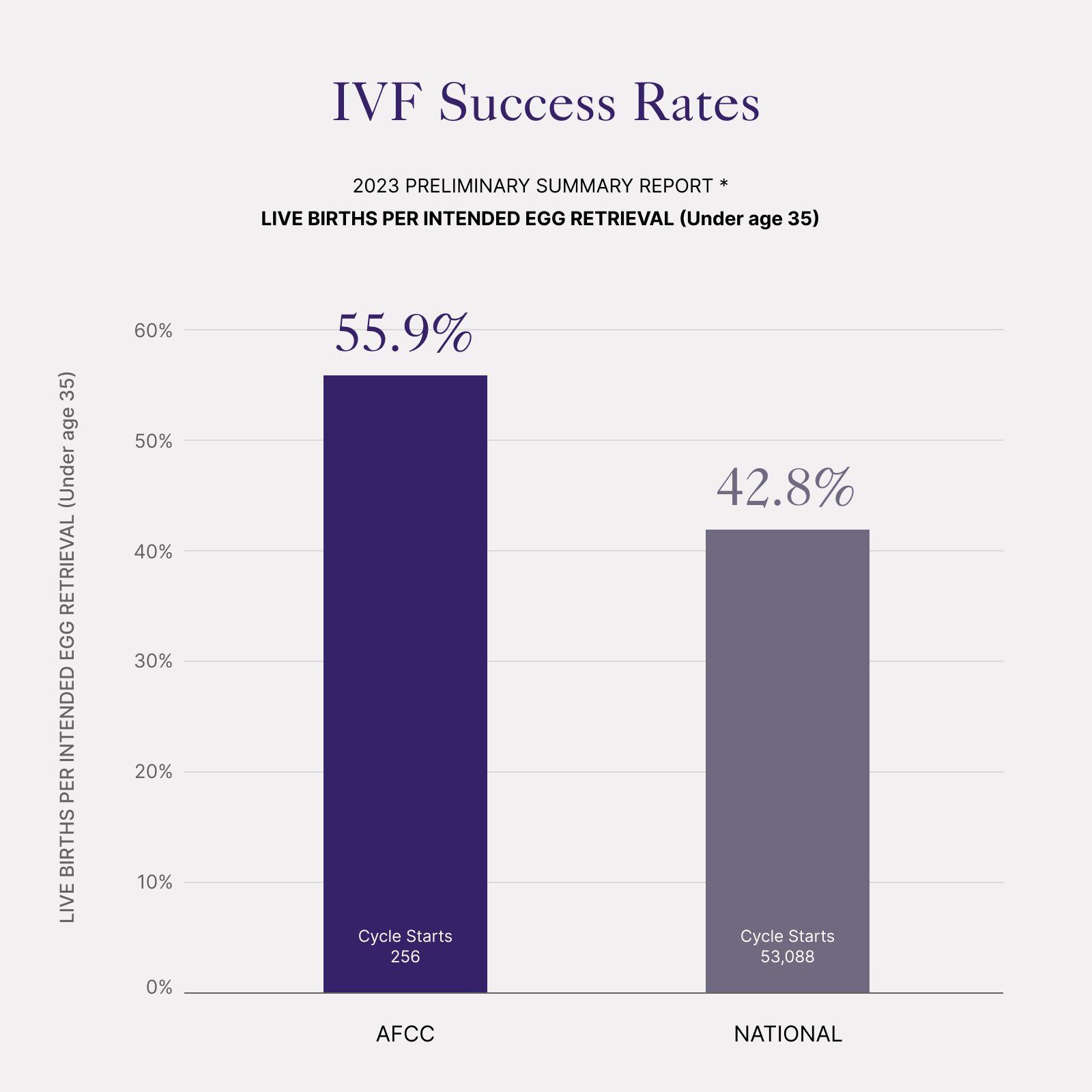
IVF patients choose Advanced Fertility Center of Chicago because of our excellent success rates, which have been over the national average for live birth rates for over 20 years.
If your treatment includes in vitro fertilization (IVF), you need assurance that you have the highest chance of achieving your goal of bringing a new life into your family. The vast majority of fertility clinics report their success rates to the Society for Assisted Reproductive Technology (SART) and CDC, making it easier for prospective parents to make an educated decision when choosing a fertility clinic. Ultimately, many patients will try to find a fertility clinic that has a demonstrated high live birth IVF success rate.
The best way to increase the success of IVF is by having the procedures done at a reputable IVF program. There are important differences in success rates between clinics. For example, if you go to the CDC or SART sites, you will find clinics with IVF live birth success rates ranging from below 10% to over 60% per egg retrieval procedure for women under age 35.
Fertility clinics are required by federal law to report their success rates. However, some clinics don't do this. When researching a fertility clinic, ask them for their recent IVF success rate statistics in writing and then check their numbers on the CDC and/or SART reports. These issues are critical and you have the right to know the information beforehand. You should ask for data regarding IVF pregnancy success rates, live birth rates, multiple pregnancy rates, and fertility care techniques from any clinic you are considering for IVF. All IVF programs have the capability of providing this information in writing. If they refuse or make excuses, it is a sign that you should work with a different fertility clinic.
However, it’s also important to keep in mind that a comparison of clinic success rates may not be meaningful because patient medical characteristics, treatment approaches, and entrance criteria for ART may vary from clinic to clinic.
In addition to the quality of the IVF program itself, other factors contribute to IVF success rates, including:
Cause of infertility
Whether the couple had a baby from a previous IVF cycle or whether they had a failed IVF cycle
Quality and number of eggs
These are all important points to keep in mind when reviewing IVF success rates.
Couples considering IVF can also evaluate the best fertility clinic for them when they have a thorough understanding of the techniques, technologies, and outcome results of any programs that they are considering.
For example, at AFCC, our goal is to achieve the highest live birth success rates possible, while minimizing risks of a multiple pregnancy, particularly high-order multiples (more than twins). In our extensive experience, we find that this is best accomplished by optimizing all laboratory and embryo culture systems, and by being cautious with the number of embryos transferred. Blastocyst embryo transfer is a technique that allows us to reduce multiple pregnancy risks while improving the odds of achieving successful implantation and pregnancy. Learn more about our IVF success rates with 5-day blastocyst embryo transfer.
Our ultimate goal is to help our patients achieve their family-building dreams. To work toward this, our highly skilled team works diligently to stay on top of quality control. We make every effort to continually improve our knowledge base and methods. We attribute our IVF success rates to:
Use of the latest technologies
Maintenance of stringent quality control
Hiring and training the best people
Commitment to ongoing learning
According to the most recent national summary support from the Society for Assisted Reproductive Technology (SART), only 26% of IVF patients are successful on the first try. IVF success on the first try decreases dramatically for patients who are ages 35 and older.
Age impacts the probability of IVF success in several ways. As women get older, their ovarian reserve diminishes in terms of both quantity and quality. Also, although men can continue to produce sperm at more advanced ages, their sperm quality, count, and motility tend to diminish as they age. Having a reduced number of eggs and/or sperm essentially means that there are fewer chances of having a successful conception and pregnancy. Furthermore, using sperm and eggs of poor quality is more likely to not fertilize or produce embryos that are not viable.
On average, most fertility patients will have to undergo two to four cycles before having a successful pregnancy. This number is typically higher for female patients who are ages 40 and older.
Reproduction and fertility care are complex processes that simply cannot guarantee success even in the best of circumstances. The most common reason for IVF failure is chromosomal abnormalities of the embryo, which is typically caused by using low-quality eggs and/or sperm.
Although many factors that impact the chances of success for IVF are beyond the patient’s control, there are a few lifestyle recommendations to support patients before, during, and after the IVF procedure, including:
Eating an IVF-healthy diet, consisting of lean proteins, vegetables, fruits, whole grains, legumes, and healthy fats
Avoiding highly processed foods
Limiting or avoiding caffeine and alcohol
Not smoking or vaping
Engaging in daily low-intensity exercises, such as walking or yoga
Getting seven to eight hours of sleep every night
Taking nutritional supplements as directed by a doctor
Reducing stress by indulging in self-care activities
All of these habits can improve your general and reproductive health while increasing your chances of having a successful IVF cycle.
We are here to answer any questions or concerns you may have so that you feel completely confident when taking the first step toward building your family.