


Interpreting Semen Analysis Results: What the Numbers Really Mean
Seeing semen analysis results for the first time can be daunting, even overwhelming.
There are numbers, percentages, abbreviations, and reference ranges—often with very little explanation attached. Many patients tell us they leave wondering: Is this bad? Is this the reason we’re struggling? What happens next?
A semen analysis is an important diagnostic tool, but no single result tells the whole story. Below, we walk through the most common parameters you’ll see, what typical reference ranges look like, and how fertility specialists interpret results in real life.
What is a semen analysis?
A semen analysis evaluates the quantity and quality of sperm in a sample. Most reports assess:
-
Volume
-
Sperm concentration (count)
-
Motility (movement)
-
Morphology (shape)
These results help doctors understand whether male factor infertility may be contributing—and how best to proceed with treatment.
Key semen analysis parameters explained (with examples)
Semen volume
What it measures: The amount of semen in the sample
Typical reference range: ≥ 1.5 mL
Example:
-
2.8 mL → within expected range
-
0.9 mL → below expected range
Low volume does not necessarily mean low sperm production. It may reflect timing, sample collection issues, or certain medical factors your doctor may explore further.
Sperm concentration (sperm count)
What it measures: Number of sperm per milliliter of semen
Typical reference range: ≥ 15 million sperm/mL
Example:
-
42 million/mL → well within range
-
12 million/mL → below reference range
It’s important to note that being below the reference range does not mean pregnancy is impossible. Many treatment options—from timed intercourse to IVF with ICSI (intracytoplasmic sperm injection)—are designed to work with lower sperm counts.
Total motile sperm count (TMSC)
What it measures: Total number of moving sperm in the entire sample
This is calculated using volume, count, and motility together.
General benchmarks (approximate):
-
>20 million: Often compatible with unassisted conception
-
5–20 million: May benefit from assisted treatment
-
<5 million: IVF/ICSI often recommended
This number is often more clinically meaningful than sperm count alone.
Motility (movement)
What it measures: Percentage of sperm that are moving
Typical reference range: ≥ 40% motile
Example:
-
55% motile → within range
-
28% motile → below range
Movement matters because sperm must travel a long distance to fertilize an egg. Lower motility can sometimes be addressed with treatment—or lab techniques that assist fertilization.
Progressive motility
What it measures: Sperm that are moving purposefully forward
Typical reference range: ≥ 32% progressive
This metric helps distinguish between sperm that are moving randomly versus effectively.
Morphology (shape)
What it measures: Percentage of sperm with typical shape
Typical reference range: ≥ 4% normal forms
This is often the most surprising result for patients.
Example:
-
6% normal → within range
-
2% normal → below range
Even when morphology is low, many patients are still able to conceive—especially with assisted reproductive techniques.
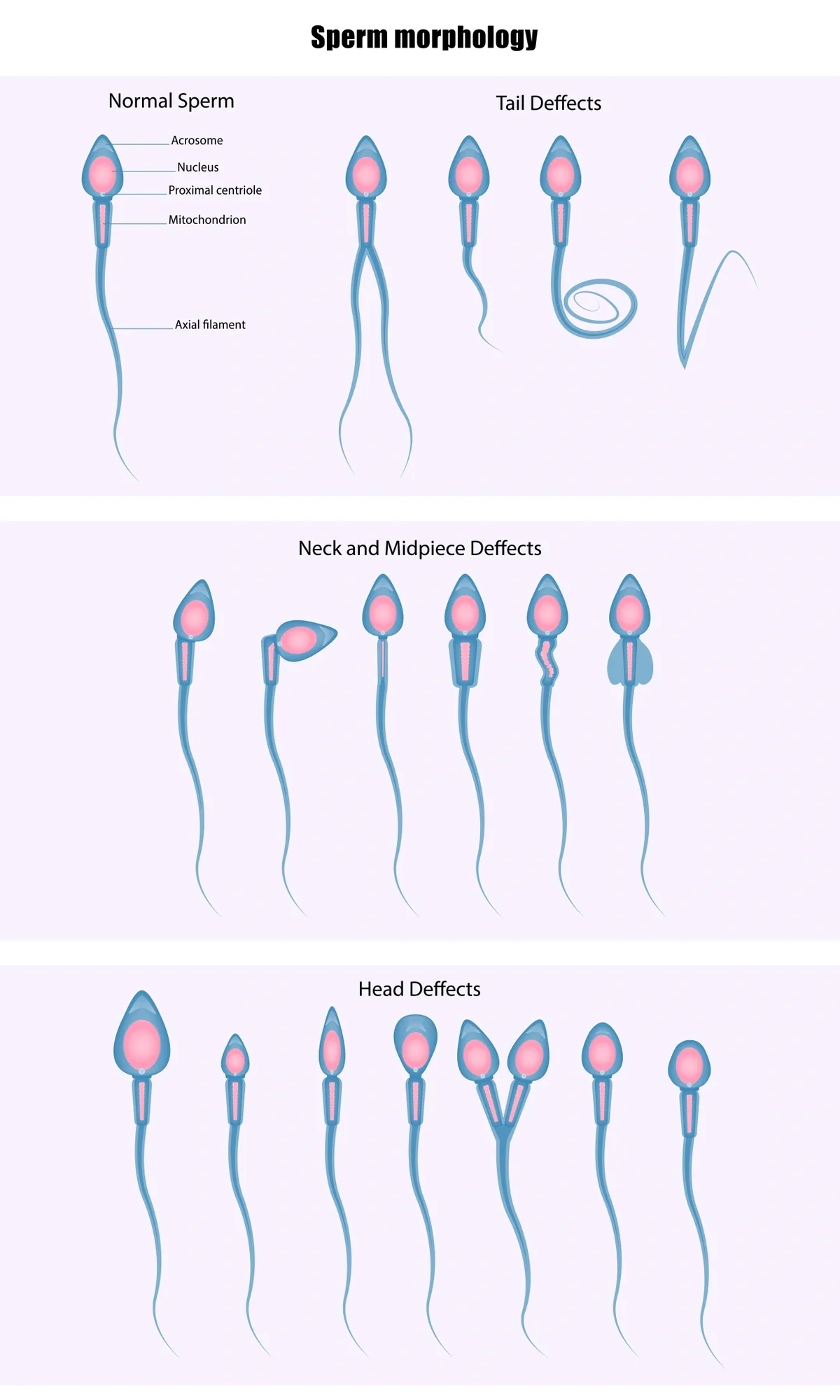
Illustration of sperm morphology
What if only one value is abnormal?
This is very common.
A single abnormal parameter does not automatically mean:
-
Severe male factor infertility
-
IVF is required
-
Pregnancy isn’t possible
Doctors look at:
-
Patterns across results
-
Repeat testing (results can vary)
-
Medical history and lifestyle factors
-
The female partner’s evaluation
Often, semen analysis is one piece of a much larger picture.
Should semen analysis results be repeated?
Yes—frequently.
Sperm production occurs in ~70–90 day cycles, which means results can change. Illness, stress, medications, fever, travel, or even the timing of abstinence before the test can affect results.
Many clinicians recommend at least two analyses before drawing conclusions.
What happens if results are outside the expected range?
Next steps depend on:
-
Which parameters are affected
-
How far outside the range results fall
-
Overall fertility goals and timeline
Possible next steps include:
-
Repeat testing
-
Lifestyle or medication changes
-
Referral to a urologist
-
Adjusting fertility treatment options
Importantly, abnormal results help guide treatment—they don’t close doors.
A note on interpretation and reassurance
Numbers can feel definitive, but fertility doesn’t operate in absolutes.
Semen analysis reference ranges describe populations—not individuals. Many patients with results outside these ranges still achieve successful outcomes, especially with personalized care.
If you’ve received semen analysis results and feel worried or confused, that reaction is completely normal. The most important step is reviewing them with a fertility specialist who can put the numbers into context and explain what they mean for you.
Categories
About the AFCC Blog
Welcome to the Advanced Fertility Center of Chicago’s blog! Here, you will find information on the latest advancements in fertility care and treatments, including IVF, IUI, third-party reproduction, LGBTQ+ family building, preimplantation genetic testing, and more. Since 1997, we’ve used our experience and continuous investment in the latest fertility technology to help thousands of patients grow their families. Contact us today for more information or to schedule a new patient appointment.