

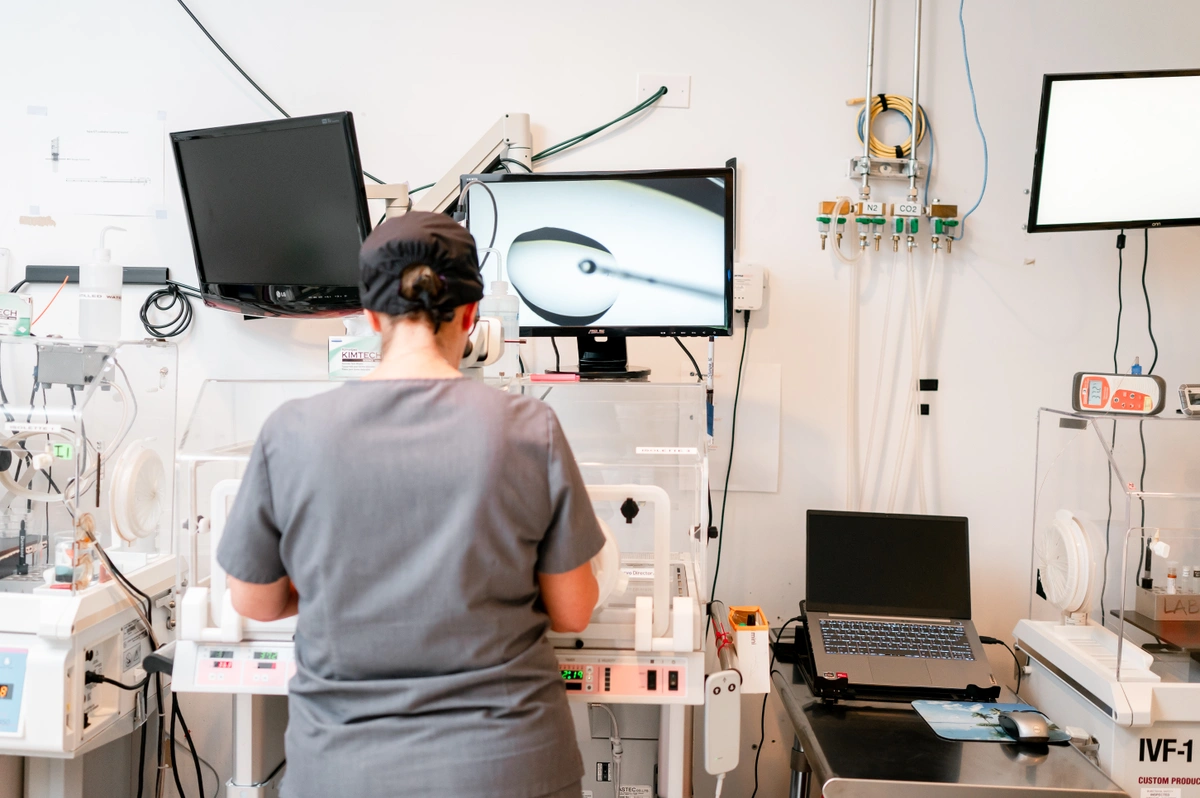
The IVF Lab Process Explained
For patients pursuing in vitro fertilization (IVF) at AFCC, some of the most intricate and crucial steps take place behind the scenes, in the lab. Once your egg retrieval is complete, your embryology team begins a series of carefully timed processes to prepare your embryos for transfer. Since the first IVF baby was born in 1978, science has advanced enormously — and today, millions of children are born through IVF every year worldwide. This guide offers an inside look at each phase of the lab process so you understand what's happening at every stage.
Step 1: Egg Retrieval
The lab process begins right after your ovarian stimulation cycle, with egg retrieval. During this minimally invasive procedure, eggs are collected from your ovaries under moderate intravenous sedation, guided by ultrasound. The eggs are transferred to the lab for immediate evaluation, where they're assessed for quality and maturity — only mature eggs move forward to fertilization.
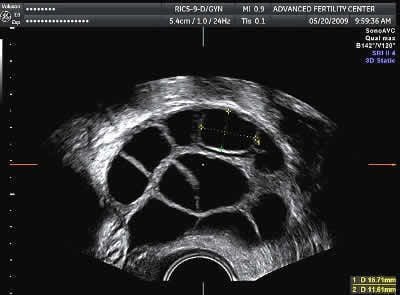
Ultrasound image of follicles (black circular areas) in a stimulated ovary
Cursors outline a 15 mm follicle
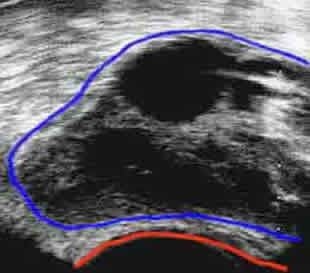
Ultrasound image of egg retrieval procedure
The egg aspiration procedure in progress - an egg is aspirated from a follicle
Ovary outlined in blue - area between red and blue lines is tissue at top of vagina
The needle is passed through the top of the vagina to get to the follicles and eggs.
The needle is the white line (along the white dots) on the right
Step 2: Sperm Collection and Preparation
Next, a sperm sample is collected from a partner or donor. In the lab, the sample undergoes sperm washing, which isolates the healthiest, most motile sperm so that only high-quality sperm are used during fertilization.
Step 3: Fertilization — Conventional IVF or ICSI?
With mature eggs and prepared sperm ready, fertilization begins, using one of two methods:
-
Conventional IVF: Eggs and sperm are combined in a dish, allowing sperm to fertilize the eggs naturally. This requires a sufficient quantity of healthy, motile sperm.
-
Intracytoplasmic sperm injection (ICSI): A single sperm is injected directly into each mature egg. ICSI is often recommended for male factor infertility or when only a limited number of healthy sperm are available.
Step 4: Embryo Culture and Development
Once fertilization occurs, the embryos are placed in a carefully controlled incubator that replicates the conditions of the human body as closely as possible. Over the next three to five days, they grow and divide while our embryologists monitor their progress. By day 3, most embryos reach an 8-cell stage; by days 5 to 7, some advance to the blastocyst stage.
Why growing to the blastocyst stage matters
Culturing embryos to day 5 or 6 does more than mark a milestone — it gives embryologists a much better view of which embryos are the strongest. Blastocysts tend to have higher implantation potential, and reaching that stage helps the team identify the single most viable embryo to transfer.
That selection is what makes elective single embryo transfer (eSET) possible, and eSET is now standard practice for most patients with a good-quality blastocyst. The reason is safety: transferring one embryo keeps success rates strong while avoiding the elevated risks that come with twins or triplets, including a higher chance of preterm birth and pregnancy complications. In other words, better embryo selection in the lab means we can aim for one healthy baby at a time, rather than trading safety for the appearance of higher odds.
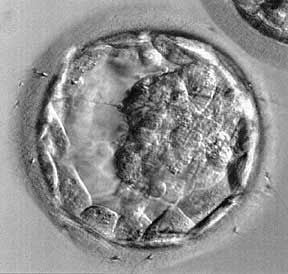
Image of Day 5 IVF embryo at the blastocyst stage
The cluster of cells on the right side are fetal cells
The other peripheral cells will become the placenta
The fluid-filled cavity of the blastocyst is on the left side
Step 5: Embryo Grading
As embryos develop, they're graded on qualities like cell structure, symmetry, and fragmentation. Grading helps identify the embryos with the highest implantation potential — though it's one piece of the puzzle, not a definitive predictor of success.
Step 6: Optional Genetic Testing
Some patients choose preimplantation genetic testing (PGT), which screens embryos for chromosomal abnormalities or specific genetic disorders. It can offer reassurance for patients with a family history of genetic conditions or recurrent pregnancy loss. PGT is typically performed around day 5, with embryos frozen while awaiting results.
Step 7: Preparing for the Embryo Transfer
While the lab nurtures your embryos, your clinical team prepares your body for transfer — often using medication to optimize your uterine lining so it's ready for implantation. Your doctor will give you tailored instructions for transfer day.
Step 8: Embryo Transfer
Embryo transfer is a quick, straightforward procedure performed without sedation. Using ultrasound guidance, your doctor places the selected embryo into your uterus through a thin catheter. Depending on your situation, this may be a fresh transfer or a frozen one in a later cycle — a decision we cover in freeze-all vs. fresh embryo transfer.
Step 9: The Two-Week Wait
After transfer, you'll enter the roughly two-week wait before a pregnancy test. Many patients find this the most challenging stretch of the journey. Our guide on what to expect after an embryo transfer walks through it day by day — and your care team is always here for questions in the meantime. We’ve also compiled these tips specifically to help with the emotional challenges the two-week wait can bring.
Freezing Extra Embryos
Any additional high-quality embryos can be frozen for future use through cryopreservation. This gives you flexibility for future family planning or additional transfers without repeating a full stimulation cycle, and frozen embryos remain viable for many years.
Frequently Asked Questions
How long do embryos grow in the lab before transfer? Usually three to seven days. Many embryos are cultured to the blastocyst stage (day 5–7), which helps the team select the strongest embryo.
What's the difference between IVF and ICSI? In conventional IVF, sperm fertilize the egg on their own in a dish. In ICSI, a single sperm is injected directly into each egg — useful for male factor infertility or when few healthy sperm are available.
Why is only one embryo usually transferred? Because culturing to the blastocyst stage lets embryologists identify the most viable embryo, a single embryo can be transferred while maintaining strong success rates — and doing so avoids the higher risks associated with twins and triplets.
Does a high embryo grade guarantee pregnancy? No. Grading is a helpful tool for selecting embryos, but it's one factor among many and not a guarantee.
What happens to embryos we don't use? Additional good-quality embryos can be frozen for future transfers, giving you options down the road without another full cycle.
Precision and Care at Every Step
Every stage of the IVF lab process at Advanced Fertility Center of Chicago is carried out with expert precision and a focus on your success and safety. If you have questions about IVF or want to discuss whether it's right for you, schedule a consultation today.
Categories
About the AFCC Blog
Welcome to the Advanced Fertility Center of Chicago’s blog! Here, you will find information on the latest advancements in fertility care and treatments, including IVF, IUI, third-party reproduction, LGBTQ+ family building, preimplantation genetic testing, and more. Since 1997, we’ve used our experience and continuous investment in the latest fertility technology to help thousands of patients grow their families. Contact us today for more information or to schedule a new patient appointment.